Showing posts with label AS Media. Show all posts

Wednesday, 23 November 2016

Analyse the structure of titles in an opening sequence

You have already looked at opening sequences, so this should not be the same as the Influences post. Instead, prior to storyboarding and scripting your film, you should do a detailed study of an opening so that you fully appreciate shot lengths and the type and number of shots that should be included.

Identify the Different Shots & Credits

One exercise you can do is to identify a film that has a similar style to one that you wish to make (in terms of title sequence, or possible in terms of genre or style) and think about how many shots there are and the length of each.
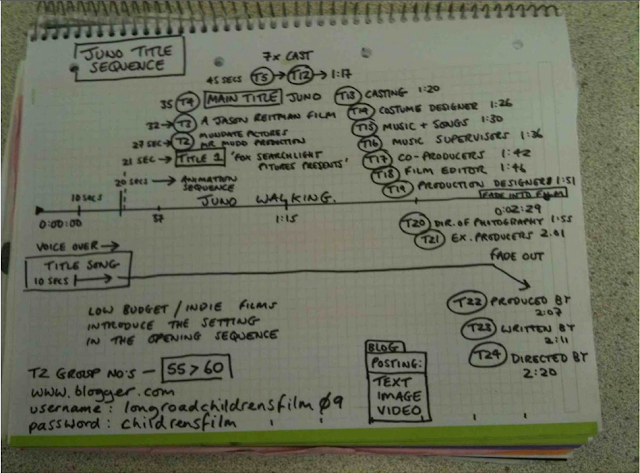

The above example is an example of a detailed study of an opening sequence. There is a video line that gives a basic idea of the visuals 'Juno Walking' (with Animation Sequence) and with each of the different credits within the film. While the sound in this case is one set song, you should aim to have a little more variation in your soundtrack.

By modelling your storyboard on an opening sequence structure that exists will allow for a far greater attention to detail and move your project towards something that is industry standard as opposed to a student video project.

You can present this close analysis in different ways- either written and scanned as above or take a still image of every title from an opening sequence and present it visually in this way.

Thursday, 3 December 2015

Tuesday, 14 April 2015

Tuesday, 10 February 2015

1st Draft Feedback & Plan

You will need to export your first draft and add it to Youtube.


You will also need to embed the Padlet onto your blog.


You should reflect on feedback you agree with and disagree with (using screenshots) and then use this as a plan to focus on 3 priorities: this may include additional filming, editing or additional sound. These need to be identified and listed.


Friday, 30 January 2015

Research Into Previous Projects

Go to http://ocrmediastudies.weebly.com/coursework-with-levels.html and make a post summarise what you have learned from previous projects.

You should focus on what aspects you thought were good and would aspire to do and reflect on what you need to avoid- do not be insulting about footage but constructive in your criticism.

Screengrabs are fine but please avoid Tubechops for this. Please bear in mind the marking criteria when discussing what you have learned, so don't discuss acting.


material appropriate for the target audience and task;

using titles appropriately according to institutional conventions;

using sound with images and editing appropriately for the task set;

shooting material appropriate to the task set;, including controlled use of the camera, attention to framing, variety of shot distance and close attention to mise-en-scene;

using editing so that meaning is apparent to the viewer and making selective and appropriate use of shot transitions and other effects.

Tuesday, 20 January 2015

Location shots

With almost any film, a crucial part of the process is to find appropriate locations (the person who does this is called a 'Location Scout') where to film. These should not only be aesthetically impressive locations but also ones that will be practical to film at (e.g. where you will not be disrupted).

In order to prove to the examiner that you have sufficiently considered different locations during pre-production, you will need to take a few photos of some if not all of the various places that you plan to film, ideally with additional pictures of any significant features of the design (e.g. a creaky door, somewhere where you plan to put a prop).

See below for an example:


You should also write a couple sentences to discuss the reason for choosing your locations- these reasons are likely to be predominantly aesthetic but practical reasons should also be briefly mentioned.

Casting Shots

Casting shots are useful in that they will help you to prove to the examiner that you have put some thought into who would be most appropriate for your film rather than simply finding someone at random. If you are able, you could even strive to have some auditions.

Ideally, you should try to do what is called a head shot of all your 'major' actors (who either appear in the majority of your film and/or have lines of dialogue). The following extract is taken from Wikipedia as some guidance of taking a head shot, and is followed by some examples of different head shots:

Theater, film, and television actors, models, singers, and other entertainers often are required to include a head shot, along with their resume, when applying for a job. These head shots are usually more artistic, intended to portray the subject in the best possible light. They often have the subject facing off-centre. A performer will often have head shots expressing different poses and expressions to give a potential employer an idea of the subject's range of appearances or expressions. Those types of head shots are called "looks." The headshots that include a person’s shoulders are called "three quarter" shots.
Actor's headshots, when printed and not simply uploaded online to an industry database, are done in an 8×10" format. Other promotional images, e.g., press shots and lobby prints, may be in many different aspect ratios. Acting headshots are usually 8×10" prints. Acting headshots are often not photographic prints but will be printed via a lithographic process or the laser process.
The main purpose of an actor's head shot is identification. Therefore the most important feature of an actor's headshot is that it looks like the subject. Actor's head shots should be clear; theatrical headshots are usually very "neutral" looking shots of the actor clearly showing his facial features.
There are a few types of Headshots:
Commercial – typically (not always) has the person smiling and projects warmth and friendliness.
Theatrical – usually serious, focused and actors are not smiling.
Glamour – More artistic and idealized images.
Headshots are intended to show a person as she is currently (age, look, style, etc.) and reflect her best qualities. Therefore, if an actor's hair is recently cut or coloured, she might then need a new headshot to reflect the new image of herself.


You should try to briefly contextualise your pictures with one or two reasons why you chose these actors- are they similar to your characters in real life? Are they drama students? Is it a practical consideration (i.e. you are in the group and so understand the project better)?

Monday, 12 January 2015

Storyboard

While you must complete at least 1 storyboard for your coursework assignment, it should also act as a valuable aid for when you film.

The concept of a storyboard is that you avoid unnecessary headaches when filming on location- camera angles, character movement and camera movement can all be worked out and you can focus instead on aspects like lighting and preparing your actors for each scene. This is especially important when working in larger groups- you should all be clear about what you need to film and how you plan to film it. This will reduce the chances of all of you giving your actors different instructions. Of course, this does not mean that you are not able to divert from your storyboard if on location you realise that a different camera angle may be better.

A storyboard should include the following information:

From the drawing:
  • What is in the frame of the shot
  • The camera angle
  • Any camera movements
  • Any character movements
Guided information:
  • Any sound effects/dialogue
  • Shot duration
  • Written camera angle (plus a possible brief description)
Your initial storyboard should be on the sheets provided but you are welcome to use a digital camera to take photos of your proposed shots and use this as the final storyboard.

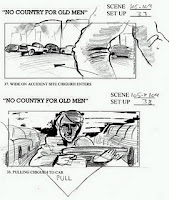
The storyboard is crucial and should not be rushed. It would likely benefit from 2 drafts, so do not spend too much time making the first draft a work of art! Below are two additional bits of help- the link features some Youtube tutorials (if you watch make sure you embed the video and discuss what you learned) and a sample storyboard image from the fantastic 'No Country For Old Men'. Please remember: this should be the moment when you think creatively about shots, not when you are 'on set'. http://filmmakeriq.com/2010/10/500-storyboard-tutorials-resources/


Finally, you will need to prepare even more by doing an animatic storyboard, which has become an expectation of AS Level students and is a much more advanced way of demonstrating your plans.  You will need to:

(1) Scan in your original storyboard

(2) Show a teacher your storyboard and act on any advice (e.g. additional shots needed) provided

(3) Take stills of each storyboard frame and put them into iMovie/Premiere Pro

(4) Add sound

(5) Adapt shot durations

(6) Add titles (consider the order)

Essentially, your storyboard should be a full reflection of what your opening sequence should look like.

H/W Write a post discussing what you have changed and what you have learned in

Below are two different examples (there are more on Youtube) of animatic storyboards. The top one is much more 'basic' and the one below a little more detailed but much more difficult to do.


Thursday, 8 January 2015

Production Ident Titles

You should all have designed a Production Ident.

On your blog, you should reflect on the construction of this ident in 2 ways:

(1) Evaluate whether you are happy about your design and why- you might touch on points about how it fits conventions, suits the target audience or discuss any other criteria.

(2) Discuss how you might use what you learned in the construction of your production ident and how you might use it in the construction of your film credits (Directed By, Starring etc.). What effects might you use that would be suitable to the genre?

Again- please be visual and please try to think about ways that you can make it more exciting.

Thursday, 18 December 2014

12BMS Feedback


See below for the different feedback for your initial ideas- you can put the relevant ones on your blog and then you will need to discuss what you have learned as you have seen following the criteria above.

There should be an appropriate level of detail and you need to consider presentation (i.e. rotate the pictures I've not had a chance to rotate!) in your post.


Wednesday, 17 December 2014

Target Audience & Production Company Ident

After having discussed possible ideas and come up with a pitch, your next focus should be on thinking about your target audience and designing a production company ident (logo) for your film. These will be discussed together as the production company ident will be largely dependent on what you decide the target audience for your film is.

Target Audience

Film company target audiences tend to be broken down into 4 categories:

Females under 25
Males under 25
Females over 25
Males over 25

Of course, you might argue that your film would appeal to more than one of these audience groups, and many films do. There are even some films that are 'four-quadrant' movies, meaning that they would have a genuine appeal for all 4 target audience groups (e.g. Toy Story 3, Inception).

You will need to have evidence on your blog that you are thinking about who would be your target audience and attached to that think about why it is that it might not appeal to other audiences. As always, you should attempt to think about your presentation!

Further Thoughts on Target Audience

You should reflect about what kind of film you are going to be making the opening of, and whether it would be considered mainstream, a slightly lower budget co-production or a niche independent production.

This would obviously have an impact on the size of your audience.

EXTENSION 1: look at some of the BFI exit polls and discuss what kinds of 'baits' of audience there might be:

http://www.bfi.org.uk/film-industry/lottery-funding-distribution/insight-reports-case-studies-audience-research/exit-polls

EXTENSION 2: look at the UK Tribes website and try to think about specific youth audience groups that may be interested in your film: use the password slwhkxwi

https://www.uktribes.com/

Production Company Ident

Your production company logo should at worstnot be distracting and at best help to reflect the tone of the film you are aiming to make.

Many major film company idents tend to reflect a wider appeal- Universal, Paramount and Dreamworks, for example.


For independent production companies who specialise in making certain films, there tends to be a slightly more themed ident.
For example, Will Ferrell and Adam McKay's production company Gary Sanchez Productions


Gunslinger Productions have made edgy social realism films like Shank, Sket and the parody Anuvahood.

Tuesday, 16 December 2014

Character Development

It will be necessary and beneficial for you to work out a slightly more 'fleshed-out' idea of your film- this will allow for some important character development and issues around tone (so, is your proposed horror film going to feature dozens of characters being killed or just one person being psychologically tortured?)

The character development aspect should focus on your main characters with a profile of what they are like- you might focus on aspects such as:
  • costume
  • personality
  • name & possibly reason
1 or 2 in-depth profiles rather than every character in your opening sequence is fine, and you are welcome to make reference to existing characters that may be an influence on your choices.

Thursday, 11 December 2014

Wallander Clip!

I know some of you have been trying to get screen grabs from Wallander but haven't been able to access the clip. Please follow instructions below to access it from FROG.

FROG- Second Dot- Departmental Sites-Shared Area- Media- Year 12 Media- Foundation Portfolio- Opening Sequences- Wallander.mp4

You can then download this file and get your screen grabs from there.

25 Word Pitch

While a good idea can quite easily be ruined by poor execution, a poor idea is much more difficult to save through good production skills.

Students often come up with overly-complicated narratives that they then struggle to contain in a brief teaser, or choose ideas that do not really 'work' in terms of allowing for interesting visual ideas.

The most important thing is to keep your ideas simple and to attempt to think visually when coming up with ideas.

Steven Spielberg said that"If a person can sell me an idea in 25 words or less, I know it'll make a good movie." Using this as a model, you will be required to provide a pitch to the rest of the class and be ready to answer any questions or field any other feedback.

Below are four different examples that may help you in terms of structure:

Egomania by Paul Alexander and Simon Braithwaite - "Hotshot young lawyer Michael Stark becomes so successful, so arrogant and so full of himself that his ego decides to go solo - with disastrous consequences."

The Cleaner by Peter Michael Rosenberg - "When a crime scene cleaner haunted by his past uncovers evidence that suggests LAPD cops are working as assassins, he becomes their next target."

Shoeless Joe by Andrew Clyde - "A holiday of a lifetime across the desolate heart of the Australian outback turns into a living nightmare for five friends."

Storage by Chris Denne and Matt Winn - "Terror stalks a storage facility. Survival for those trapped inside depends on the secrets in those endless units. But some doors are better left locked."

Genre Influences

Having seen the variations of opening sequences as a class, it is crucial that you find additional sources of influences that are more interesting/ personalised for you. At this stage, you are looking to focus on:

- influences in terms of genre

Again, these should be shown on your blog with visual elements included (stills from the opening of the film) focusing on specific detail of the conventions in terms of:

- production ident
- titles
- tone
- sounds
- characters

Friday, 5 December 2014

Wednesday, 3 December 2014

Mood Board


For your opening sequence, the precise storyline is not assessed. However, a poor storyline often will make it a struggle for you to obtain the higher marks in your production.

While we will focus on more specific aspects of storyline next week, one way to assist the process of coming up with a suitable story is to do a mood board.

A mood board is a poster that consists of images, bits of text, objects or anything else that may convey ideas of design for a project. It is used by many people within different creative occupations in order to begin to get ideas of the tone and look that they wish to bring into their projects.

You will need to design some kind of mood board in order to ensure that your story ideas are not just guided by a one-sentence story but also informed by a visual style you want to incorporate. Each of you should do this individually to reflect your aesthetic interests.

This should be labelled 'Planning'.

Tuesday, 2 December 2014

Brief

While this was given to you by Miss Mitchell, see below for the brief:

Main task: the titles and opening of a new fiction film, to last a maximum of two minutes.

Thursday, 27 November 2014

What is an Opening Sequence? Three Case Studies

One of the first things that will need to be on your blog is a discussion of what an opening sequence actually entails. While this is an incredibly broad question that very much differs between films, by analysing the 3 different opening sequences looked at in class you can begin to see what all opening sequences include as well as seeing what differences in style there are between some openings.


You will need to briefly discuss each case study in terms of:
  • What conventions of opening sequences they contain?
  • What makes each unique in terms of being an opening sequence?
  • Pick out 2 interesting aspects of the style (comment on either any interesting camera shots, edits, sound or mise-en--scene) 
  • Offer your opinion of the opening
You should finish with a brief explanation of your conclusions of an opening sequence. Try to have a flexible approach: 'While they must have a production ident and most feature ..., only some will feature...'


You will need to use stills, tubechop or reference timings of clips to help make your points more specific and detailed.


The Bourne Supremacy


Brick


Sweeney Todd