Wednesday, 23 November 2016

Analyse the structure of titles in an opening sequence

You have already looked at opening sequences, so this should not be the same as the Influences post. Instead, prior to storyboarding and scripting your film, you should do a detailed study of an opening so that you fully appreciate shot lengths and the type and number of shots that should be included.

Identify the Different Shots & Credits

One exercise you can do is to identify a film that has a similar style to one that you wish to make (in terms of title sequence, or possible in terms of genre or style) and think about how many shots there are and the length of each.
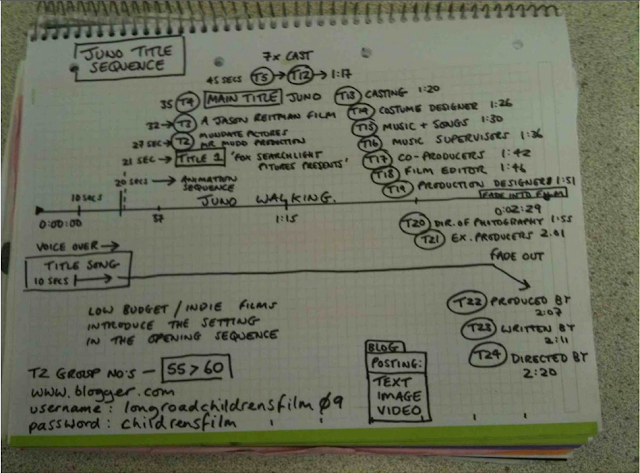

The above example is an example of a detailed study of an opening sequence. There is a video line that gives a basic idea of the visuals 'Juno Walking' (with Animation Sequence) and with each of the different credits within the film. While the sound in this case is one set song, you should aim to have a little more variation in your soundtrack.

By modelling your storyboard on an opening sequence structure that exists will allow for a far greater attention to detail and move your project towards something that is industry standard as opposed to a student video project.

You can present this close analysis in different ways- either written and scanned as above or take a still image of every title from an opening sequence and present it visually in this way.

Monday, 23 May 2016

Thursday, 24 March 2016

Thursday, 3 December 2015

Tuesday, 20 October 2015

Focus Group Advice

You will need to ask 5 questions to a group (3-4 people)- ideally most/all will be from your target audience. You can film this on your phone or any other device, provided you can access and edit the footage.

The idea is to have a group discussion- so aim to ask questions that get people discussing rather than yes/no questions.

This is a really good opportunity to find out first hand what your audience may respond to.

Exemplar questions (welcome to adapt/use these)

1. Why do you think people pirate films and television shows?

2. Do you think piracy is an okay thing to do?

3. Do you think piracy affects the British film and television industry? Do you care?

4. What kind of things may appeal to a 15-30 audience to promote anti-piracy?

5. If you were making an anti-piracy ad, what would you include?

Monday, 28 September 2015

Links for Sociology Family

For each of the family structures below:

(1) Briefly explain the structure
(2) Discuss either a Functionalist/Marxist/Feminist approach to the structure, thinking which may be most appropriate

http://www.everyculture.com/South-Asia/Nayar-Marriage-and-Family.html - the Nayar people

http://en.wikipedia.org/wiki/Kibbutz - Kibbutzim

http://en.wikipedia.org/wiki/Foster_care - foster care

http://www.thewhocarestrust.org.uk/pages/childrens-homes.html - children’s homes

http://www.livescience.com/6073-children-raised-lesbians-fine-studies-show.html - lesbian parents

http://www.livescience.com/17913-advantages-gay-parents.html - gay parents

Thursday, 24 September 2015

Tuesday, 15 September 2015

Tuesday, 8 September 2015

AS Film Assignment: Cinematography

Use the Powerpoint below to help you with answering the questions on the Cinematography worksheet.


Below are clips from the films Speed Racer (2008) and The Assassination of Jesse James By The Coward Robert Ford (2007).


Using the keywords and the examples we looked at in class discuss the differences in cinematography between the two. If you are struggling in comparing, write a separate discussion for each in terms of the 'look'.


Focus on 'quality' points in more detail rather than describing every shot. You should aim to write about 250- 500 words words and have it ready to hand in for the next lesson.


Tuesday, 30 June 2015

Extra Challenge Research: Director Case Study

While not compulsory, one way in which to make your blog stand out from others is to delve deeper in your research and do a case study about a specific music video director and identify their particular 'auteur' style- essentially look for stylistic devices that they consistently use in their videos that you may bring to your production work.

The website www.imvdb.com provides a music video database and can be used to demonstrate the work from various directors. You may wish to do it in terms of a specific genre of music video.

Below are a list of examples of music video directors that may be interested to do some further research on:

Romain Gavras- dark, gritty, high energy videos predominantly by electronic music artists (M.I.A., Justice, Simian Mobile Disco)

Daniels- high concept, plot heavy, amusing videos for 'indie' rock artists (Foster The People, Tenacious D and The Shins)

Yoann Lemoine- saturated colours and a slightly melancholic feel for a series of female singers (Lana Del Rey, Katy Perry, Taylor Swift)

Hype Williams- legendary music video director, predominantly hip-hop and R & B. More than 100 videos over 20 years (recently Nicki Minaj, Ja Rule, Busta Rhymes)

As always, try to share the information in a visually interesting manner. Below is a sample of a Glog I created about the music video director Tom Scharpling, who won the Spin Magazine Music Video Director of the Year in 2012- please click on the links if you are curious to see some of his videos!

Tuesday, 14 April 2015

Friday, 6 March 2015

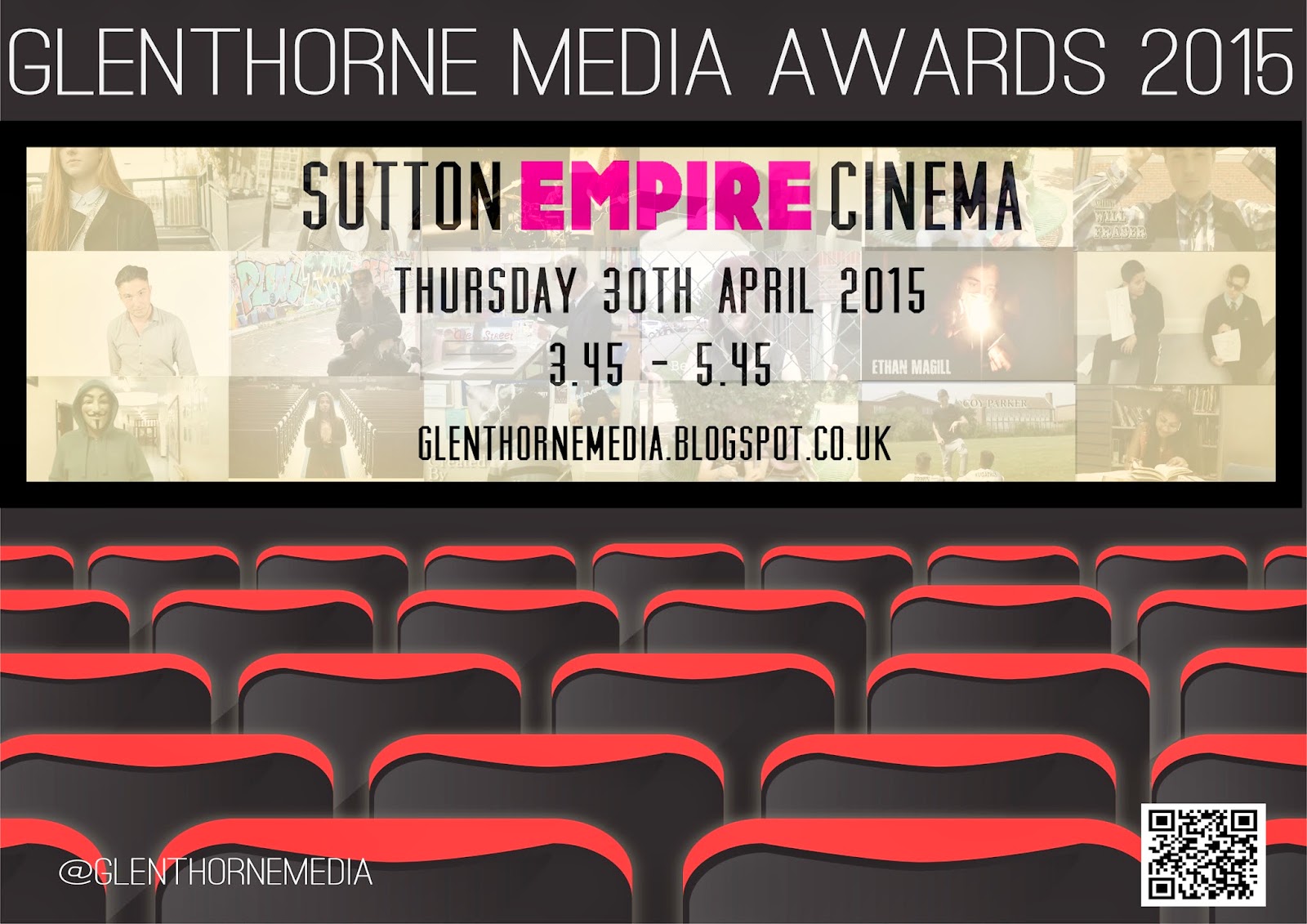
Media Awards 2015


This years Media Awards will be held at Sutton Empire Cinema on Thursday the 30th of April 2015.

The evening is designed to celebrate and showcase the achievement of our Media students and their high standards of practical and academic work. We're really excited to be able to showcase our students films on the big screen. 

More information on this exciting event, tickets and the schedule of the night to follow!


Trailers


Tuesday, 10 February 2015

1st Draft Feedback & Plan

You will need to export your first draft and add it to Youtube.


You will also need to embed the Padlet onto your blog.


You should reflect on feedback you agree with and disagree with (using screenshots) and then use this as a plan to focus on 3 priorities: this may include additional filming, editing or additional sound. These need to be identified and listed.


Friday, 30 January 2015

Research Into Previous Projects

Go to http://ocrmediastudies.weebly.com/coursework-with-levels.html and make a post summarise what you have learned from previous projects.

You should focus on what aspects you thought were good and would aspire to do and reflect on what you need to avoid- do not be insulting about footage but constructive in your criticism.

Screengrabs are fine but please avoid Tubechops for this. Please bear in mind the marking criteria when discussing what you have learned, so don't discuss acting.


material appropriate for the target audience and task;

using titles appropriately according to institutional conventions;

using sound with images and editing appropriately for the task set;

shooting material appropriate to the task set;, including controlled use of the camera, attention to framing, variety of shot distance and close attention to mise-en-scene;

using editing so that meaning is apparent to the viewer and making selective and appropriate use of shot transitions and other effects.

Wednesday, 28 January 2015

Interactive Media Academy Auditions

Please see below for a series of YouTube tutorials for Blender. Please again note that you will not be solely assessed in terms of how far you get- if you don't finish in the hour this does not mean you fail your audition, so you are better off following the instructions clearly rather than skipping any steps.

You should ensure you save your Blender progress after each tutorial so you do not need to start again if you encounter an issue.


Tuesday, 20 January 2015

Location shots

With almost any film, a crucial part of the process is to find appropriate locations (the person who does this is called a 'Location Scout') where to film. These should not only be aesthetically impressive locations but also ones that will be practical to film at (e.g. where you will not be disrupted).

In order to prove to the examiner that you have sufficiently considered different locations during pre-production, you will need to take a few photos of some if not all of the various places that you plan to film, ideally with additional pictures of any significant features of the design (e.g. a creaky door, somewhere where you plan to put a prop).

See below for an example:


You should also write a couple sentences to discuss the reason for choosing your locations- these reasons are likely to be predominantly aesthetic but practical reasons should also be briefly mentioned.